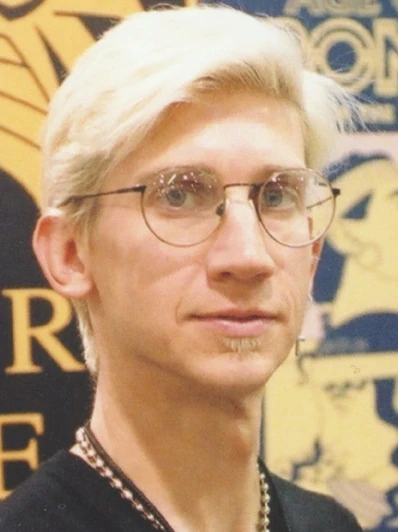

Eric Shanower (October 23, 1963-) is a comic book artist, illustrator, and writer. He has created five graphic novels based on the Oz books, as well as illustrating many Oz-related stories for Marvel Comics.
Shanower became an official Oz fan when he read L. Frank Baum's fifth Oz book The Road to Oz as a child after being a fan of the classic MGM musical movie. Though he says he still watches it from time to time and still enjoys it, to him, the 1939 film is not Oz.
Shanower served as assistant editor of Oz-story Magazine during that annual's six-year duration (1995-2000); he also supplied much of the artwork for each volume. His novel The Giant Garden of Oz, which he both wrote and illustrated, was published in 1993, and his collection of Oz fiction and verse, The Salt Sorcerer of Oz and Other Stories, appeared in 2002.
His story "Abby," published in Oz-story Magazine No. 2 in 1996, has a strong relationship with The Shaggy Man of Oz, and is almost an homage to Jack Snow's book. Trot of Oz, his collaboration with Glenn Ingersoll, appeared in the final issue of Oz-story in 2000. He illustrated Paradox in Oz by Edward Einhorn in 1999.
Shanower also produced The Oz Toy Book Volume 2 in 1994.
Most significantly, in 1993 he illustrated The Wicked Witch of Oz, written by Royal Historian Rachel Cosgrove Payes. This book is considered canonical by many fans, not unlike the other Oz material that Shanower has been associated with.
Graphic Novels
- The Enchanted Apples of Oz (1986).
- The Secret Island of Oz (1986).
- The Ice King of Oz (1987).
- The Forgotten Forest of Oz (1988). The Wood Nymph Nelanthe is exiled from the Forest of Burzee for kissing a human male. She becomes the consort of the king of the trolls; she rides a giant talking bat. She provokes a revenge attack on Burzee by the trolls and their fire-dragon allies. Dorothy and Toto, the Scarecrow and Sawhorse are drawn into the action. A repentant Nelanthe foils the invasion by sowing dissension between trolls and dragons; Queen Zurline forgives her and welcomes her back to Burzee.
- The Blue Witch of Oz (1992). Dorothy and the Scarecrow go in search of the Good Witch of the East, long missing. They find her in the Great Gray Gillikin Swamp; Bungle breaks the enchantment afflicting the witch. She is restored to a constructive role in Oz society.
The five graphic novels were later reprinted in a single collected edition, Adventures in Oz (2006). They are also collected in the two-volume series Little Adventures in Oz (2010), which includes some special features such as Shanower's short sketch "General Jinjur of Oz."
Beyond his Oz-related works, Shanower is also known for Age of Bronze, a retelling of the story of the Trojan War in comics format.
His partner of about 30 years, David Maxine, is working on a book entitled The Wizard of Oz on Broadway as he runs a blogspot website that is almost dedicated entirely to the history of the 1902 play.