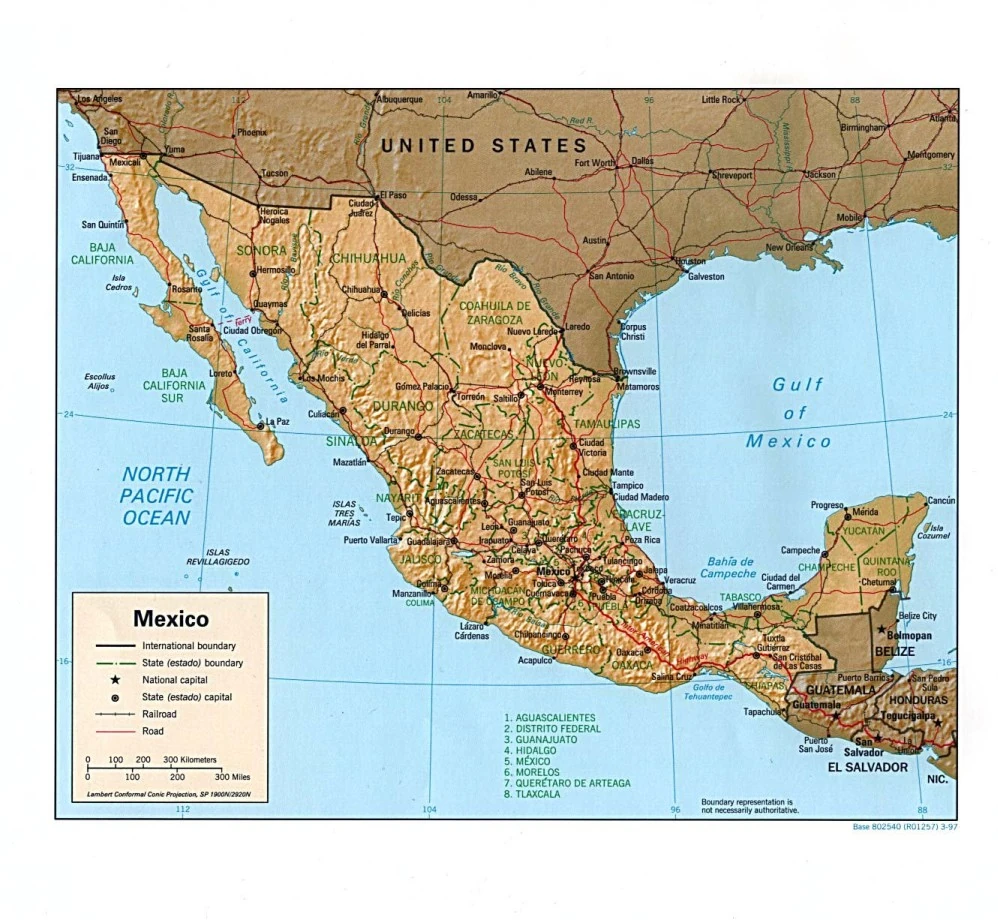

Los Estados Unidos Mexicanos (The United Mexican States) (or simply Mexico) is a federal constitutional republic in North America. It is bordered on the north by the United States of America; on the south and west by the Pacific Ocean; on the southeast by Guatemala, Belize and the Caribbean Sea; and on the east by the Gulf of Mexico. Mexico is a federation comprising 31 states and a federal district, the capital Mexico City, whose metropolitan area is one of the world's most populous.
After gaining independence from Spain's empire in 1821, Mexico had a slew of civil wars, coups d'etat, and drastic shifts of government, between 1823 and 1876. Autocratic President Porfirio Diaz maintained a secure dictatorship ("Porfiriato") from 1876-1911, but in his weakening years was overthrown and there began a new decade of internal strife, known as the Revolution, which claimed somewhere between 1.7–2.7 million Mexican deaths between 1910 and 1920. Since the 1920s, Mexico has had a fairly stable continuity of government, but has been infamously bedeviled by organized crime, corruption, and poverty.
Mexico plays a significant role in lesser known works by American novelists L. Frank Baum and W.W. Denslow, whose writing career coincided with the Porfiriato and the Revolution.
The title characters of Denslow's Scarecrow and Tin Man (1904-5) briefly sojourn in Mexico and get up to slapstick hijinks, during the later years of the Porfiriato.
In chapter XVI of Baum's The Emerald City of Oz, the Shaggy Man says he has been to Mexico.
Much of Baum's The Flying Girl and Her Chum (1912, sequel to The Flying Girl) takes place on an island of the Baja California coast, and the Revolutionary climate informs much of the drama. Francisco Madero, the real life President of Mexico at the time, plays a background role but does not appear directly.